Biography
Le Pho, 1907–2001
A mandarin's son from Tonkin who entered the first class of the Hanoi art school, left for France at thirty, and never went back. He said there was not a moment he did not remember it.
1907–1925A mandarin's son
Lê Phổ was born on August 2, 1907, at Hà Đông, near Hanoi.1 He came from one of the great mandarin families of Tonkin.2 His father, Lê Hoan, was the governor of Hải Dương province and an imperial official allied with the French, and he took part in the hunt for the anti-colonial leader Hoàng Hoa Thám.3
The boy hardly knew him. His wife said later that he remembered nothing of his father except that he smoked opium.4 He lost his mother very young as well, and he grew up with an older brother and sister-in-law, where he was blamed for whatever trouble the nephews and nieces caused.4 He said little to his own children about those years. His son Alain thought the mothers and family scenes in the paintings might come from having never known his mother.5
He had a classical schooling, including Chinese characters, and at the Lycée du Protectorat in Hanoi he perfected his French and met Mai Trung Thứ, who would be his friend for life.2 By 1924 he was painting oil portraits of his father, his sister and his brother-in-law.6
1925–1931The first class
In 1925 he sat the first entrance examination of the new École des Beaux-Arts de l’Indochine in Hanoi and was admitted to its first class.6 The school had been founded by the French painter Victor Tardieu with the Vietnamese painter Nam Sơn. In the mornings Joseph Inguimberty taught drawing, painting and life modelling. In the afternoons Nam Sơn taught East Asian decorative arts.6
Le Pho went from class to the library, where he read on Tang and Han sculpture and on Song and Ming painting.6 He became Tardieu’s favorite pupil.7 His wife called Tardieu a spiritual father to him.4 What he remembered of the teaching was a warning against copying.
“When he taught us, Mr. Tardieu did not want us to imitate Western painting, but to hold firmly to our own tradition.”7
While still a student he received his first commission, a large oil on canvas for the Maison de l’Indochine at the Cité universitaire in Paris, dated 1929.2 It is still in the building, now the Maison des étudiants de l’Asie du Sud-Est.8 He graduated with the first class in 1930.6
1931–1932Paris and Europe
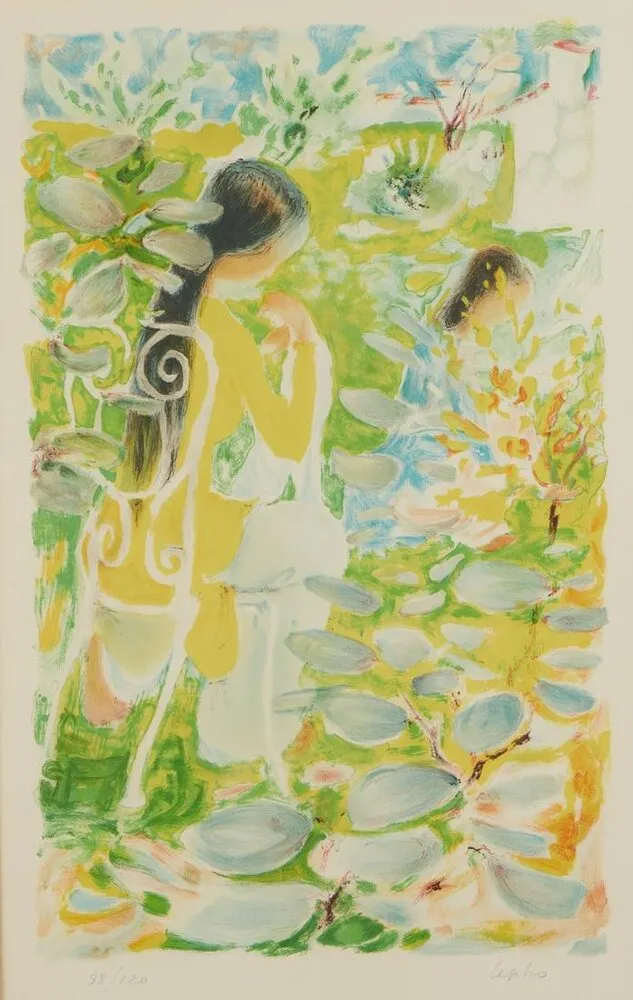
In the spring of 1931 Tardieu sent him to Paris to work under Pierre Guesde, chief commissioner of the Indochinese pavilions at the Exposition coloniale. He oversaw the school’s display inside the replica of Angkor Wat, and for weeks he hardly left the site, deciding where each painting should hang.6 That year he also showed three paintings at a colonial art exhibition in Rome.6
He then toured Western Europe with Tardieu, through France, Italy, the Netherlands, Belgium and Germany.6 Vũ Cao Đàm joined him in Paris in December 1931.2 The Renaissance court portraits he saw in Florence stayed with him, as his next venture would show.
1932–1937Hanoi
Back in Hanoi by 1933, he taught drawing and lived among the city’s intelligentsia in a lakeside villa.9 He designed clothes as well as paintings. In the mid-1930s he ran a fashion house, making áo dài with white frilled cuffs that came from those Florentine portraits, and he designed niello jewelry.6
His portraits reached the court. Emperor Bảo Đại admired them on a visit to the school in 1933, and in 1935 he was invited to Huế to paint the Emperor and Empress Nam Phương and to decorate the inner palace.7 He traveled to Beijing, where he visited the Palace Museum, and to Cambodia in 1936.6 He gave up lacquer because he was allergic to it, which is why his lacquers are few and early.1
1937–1945France for good
In 1937 he returned to Paris to set up the Indochina section of the Exposition internationale, and this time he stayed.2 Tardieu died in Hanoi that June, a few weeks after he arrived.7 Mai Trung Thứ reached Paris in the summer.2
The three friends became neighbors. They helped one another through hard times and shared their dealers and clients. They no longer drew a teacher’s salary and had to live from their art, and they worked on silk in a common style.2 The historian Phoebe Scott has argued that the market helped shape that style, with its idealized scenes of Vietnamese women.10
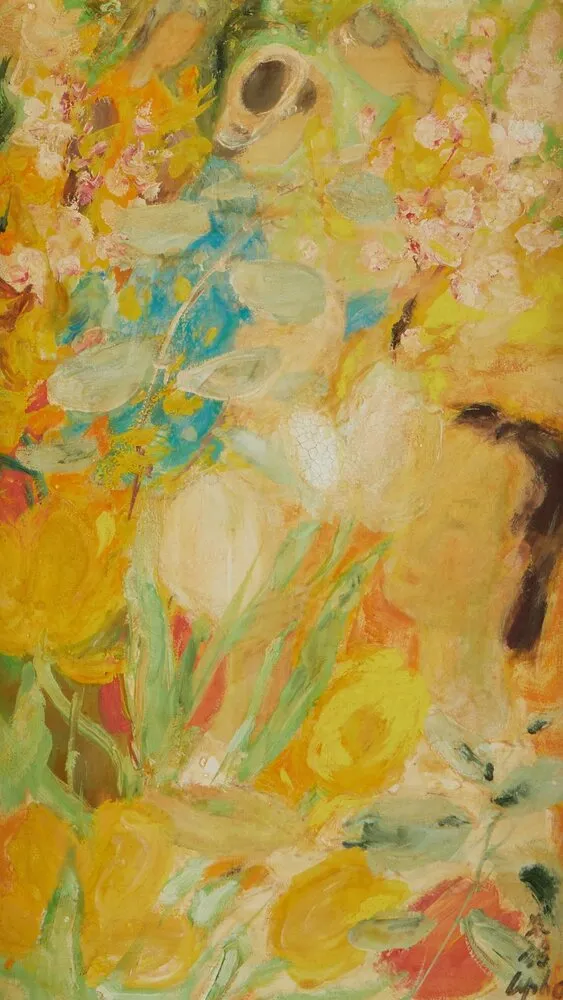
In 1939 he enlisted in the French army.2 After his discharge he went to Nice and took a flat on the Promenade des Anglais.9 There the dealer André Romanet found his work and began to show it, in Algiers and later in Paris.11 On the Riviera around 1943 he met Henri Matisse, and his palette grew lighter afterwards.12 He returned to Paris late in 1943.2
1945–1963Rue de Vaugirard
He met Paulette Vaux in 1945, a journalist for Time and Life in France.12 They married in June 1947 and moved to 235 bis rue de Vaugirard, which was his home for the rest of his life.7 Their sons were born in 1947 and 1950. Alain Le Kim became a photographer, and Pierre Le-Tan became an illustrator known for his New Yorker covers.13 He was, Alain remembered, an inveterate art hunter who took his boys to the flea market at Saint-Ouen.9
In 1946 he met Ho Chi Minh, who was in France for the Fontainebleau talks.2 His family kept a photograph inscribed to him by the Vietnamese leader.14 For a few years from 1950 he advised the Vietnamese embassy in Paris.15
His silks of these years, shown at the Galerie Romanet in Paris, have stronger color than the earlier ones. From about 1955 he began to add oil to the gouache and ink, a first step toward the later work.12 He showed alongside Foujita in Lyon, Avignon, Nice and Bordeaux in 1957 and 1958.7
1963–c. 1990The Findlay years
In 1963 or 1964 he signed with Wally Findlay Galleries through its Paris branch on avenue Matignon, and his son dates the rise of his career to that contract.5 Vu Cao Dam worked with the same dealer. Findlay’s advice was simple: keep the motifs, but use larger canvases and brighter colors.16 From then on Le Pho traveled to the United States each year, showing in New York, Palm Beach and Chicago.7
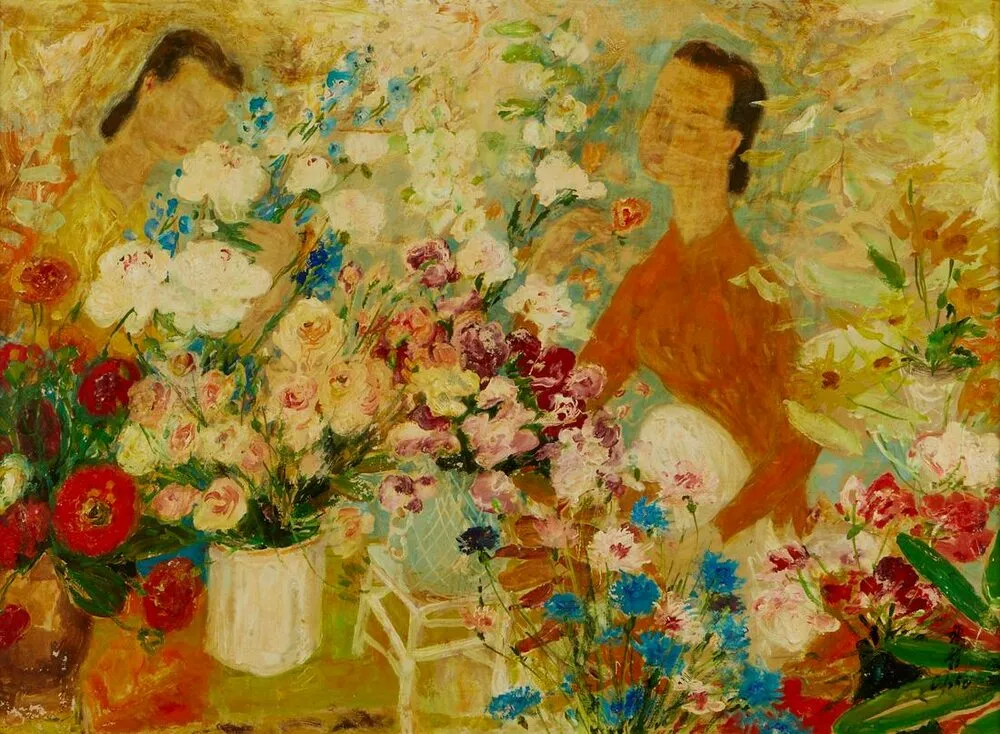
He worked almost entirely in oil on canvas now, painting women in gardens and bouquets that he told an expert were always done from “just cut flowers.”12 The critic Waldemar George published a monograph on him in 1970.17 He left many works undated and hesitated over the dates himself, even when correcting them in George’s book.12
The market has come to prize the early silks most. Asked in 1995 which period he liked best, he did not hesitate: “my Findlay period.”12
c. 1990–2001Last years
A road accident ended his painting, at the end of the 1980s or in 1990 by different accounts.12 In old age, at the rue de Vaugirard, he would pose for admirers with brush and palette before a painting that stayed unfinished year after year.12 His obituary tells of a trip to Lyon on which he found one of his own paintings of 1930 for sale and bought it back.14
He never returned to Vietnam.14 In 1993 he spoke about what that had cost him.
“I have been in France for sixty years, I hold French citizenship, but there has not been a moment when I have not remembered my homeland.”14
He said then that he had set aside twenty paintings for the Vietnam Fine Arts Museum.14 He died in Paris on December 12, 2001.14
Museums have since caught up with the market. National Gallery Singapore holds Harmony in Green: The Two Sisters and added his 1931 Jeune fille en blanc to its collection in 2023.18 In 2024 the Musée Cernuschi in Paris devoted a major exhibition to him, Mai Trung Thứ and Vũ Cao Đàm, and in 2025 National Gallery Singapore included him in City of Others: Asian Artists in Paris, 1920s–1940s.2 In Scott’s account he had the most significant impact of the four artists who went to Paris.10
Footnotes
-
Arnauld Le Brusq, “Lê Pho (1907–2001)”, Encyclopædia Universalis. ↩ ↩2
-
Musée Cernuschi, press text for Lê Phô, Mai-Thu, Vu Cao Dam: Pionniers de l’art moderne vietnamien en France, 2024, reprinted by FranceFineArt. ↩ ↩2 ↩3 ↩4 ↩5 ↩6 ↩7 ↩8 ↩9 ↩10 ↩11
-
Le Brusq, “Lê Pho”; Thụy Khuê, “Bộ tứ Đông Dương bên trời Âu (Kỳ 2): Họa sỹ Lê Phổ”, Art Republik Việt Nam, 2021. ↩
-
Lan Hương, “Lê Phổ: nghệ sĩ bậc thầy trường phái hậu ấn tượng”, Sài Gòn Tiếp Thị, September 14, 2009, quoting Paulette Vaux. ↩ ↩2 ↩3
-
Alain Le Kim, interview in “The Vietnamese Spirit: A Royal Collection and an Enduring Friendship,” sale essay. ↩ ↩2
-
“Pioneering Modern Vietnamese Art: Le Pho’s Journey from the Early Years to 1937,” sale essay. ↩ ↩2 ↩3 ↩4 ↩5 ↩6 ↩7 ↩8 ↩9 ↩10
-
Thụy Khuê, “Bộ tứ Đông Dương bên trời Âu (Kỳ 2): Họa sỹ Lê Phổ”, Art Republik Việt Nam, 2021. ↩ ↩2 ↩3 ↩4 ↩5 ↩6 ↩7
-
Région Île-de-France, “La Maison des étudiants de l’Asie du Sud-Est”. ↩
-
Sale-catalogue essay on the artist’s life and family, including recollections by Alain Le Kim. ↩ ↩2 ↩3
-
As reported in an ISEAS seminar summary. See also Phoebe Scott, “Colonial or Cosmopolitan? Vietnamese Art in Paris in the 1930s–40s,” Southeast of Now 3, no. 2 (2019). ↩ ↩2
-
Sale-catalogue note on André Romanet’s exhibitions in Algiers. ↩
-
Jean-François Hubert, “Le Pho’s Three Periods: Early Works, Romanet, Findlay,” 2020, and his other published notes on the artist. ↩ ↩2 ↩3 ↩4 ↩5 ↩6 ↩7 ↩8
-
Thụy Khuê, “Họa sỹ Lê Phổ”; “L’illustrateur Pierre Le-Tan est mort”, Livres Hebdo, 2019. ↩
-
Trần Văn Mỹ, “Vĩnh biệt Lê Phổ: Danh họa Việt Nam trên đất Pháp”, Đại Đoàn Kết, December 30, 2001. ↩ ↩2 ↩3 ↩4 ↩5 ↩6
-
Sale-catalogue chronology of the artist. An inventory text from the Île-de-France region gives 1950 to 1957 for the same post. ↩
-
Sale announcement describing the dealer’s advice to Le Pho and Vu Cao Dam. ↩
-
National Gallery Singapore, Jeune fille en blanc, 1931, accession 2023-00424. ↩
Chronology
-
1907Born August 2 at Hà Đông, near Hanoi, into a mandarin family. source
-
1925Admitted to the first class of the École des Beaux-Arts de l'Indochine in Hanoi.
-
1928First shows work in Hanoi, with Vũ Cao Đàm and Mai Trung Thứ. source
-
1929Paints his first commission, a large canvas for the Maison de l'Indochine at the Cité universitaire in Paris. source
-
1930Completes L'âge heureux and graduates with the first class.
-
1931Sent to Paris to help mount the Indochina display at the Exposition coloniale. Shows three paintings in Rome. Tours Western Europe with Victor Tardieu.
-
1932–33Returns to Hanoi and teaches drawing. source
-
1933Emperor Bảo Đại visits the school and admires his portraits.
-
1934–35Travels to Beijing and visits the Palace Museum.
-
1935Invited to Huế to paint Emperor Bảo Đại and Empress Nam Phương. source
-
1936Visits Cambodia.
-
1937Returns to Paris for the Exposition internationale and settles in France. Victor Tardieu dies in Hanoi on June 12. Mai Trung Thứ joins him and Vũ Cao Đàm in Paris. source
-
1938First solo exhibition in Paris. source
-
1939Enlists in the French army. source
-
1939–40Discharged, he goes to Nice. source
-
1941–42The dealer André Romanet shows his work in Algiers.
-
1942–43Meets Henri Matisse on the Riviera.
-
1943Returns to Paris late in the year. source
-
1945Meets Paulette Vaux. Shows with Vũ Cao Đàm and Mai Trung Thứ at the Galerie Roux-Hentschel in Paris. source
-
1946Meets Ho Chi Minh during the Fontainebleau talks. source
-
1947Marries Paulette Vaux in June. They move to 235 bis rue de Vaugirard, his home for life. Son Alain Le Kim is born. source
-
1948Exhibits at the Galerie Van Loo in Brussels.
-
1950Son Pierre Le-Tan is born. Becomes artistic adviser to the Vietnamese embassy in Paris.
-
c. 1955Begins adding oil to gouache and ink on silk.
-
1956Silk paintings shown at the Galerie Romanet in Paris.
-
1957–58Exhibits alongside Foujita in Lyon, Avignon, Nice and Bordeaux. source
-
1960Exhibits in San Francisco. source
-
1961Le Pho, peintures sur soie at the Galerie Romanet, Paris, in April.
-
1963Exhibits in Caracas and sends five paintings, later lost, to an international exhibition in Saigon. source
-
1963–64Signs with Wally Findlay Galleries.
-
From 1964Travels to the United States each year, showing in New York, Palm Beach and Chicago. source
-
1970Waldemar George publishes the monograph Le-pho. source
-
c. 1990A road accident ends his painting.
-
1993Says he has set aside twenty paintings for the Vietnam Fine Arts Museum. source
-
2001Dies in Paris on December 12. source
-
2023National Gallery Singapore acquires Jeune fille en blanc (1931). source
-
2024–25Lê Phô, Mai-Thu, Vu Cao Dam at the Musée Cernuschi, Paris. source
-
2025Shown in City of Others: Asian Artists in Paris, 1920s–1940s at National Gallery Singapore. Hải Quỳ enters the Ho Chi Minh City Museum of Fine Arts. source