Biography
Vu Cao Dam, 1908–2000
A Hanoi scholar's son who trained as a sculptor, sailed for France at twenty-three, and never saw Vietnam again. For the next seventy years he made Vietnam his subject.
1908–1925Rue des Briques
Vũ Cao Đàm was born on January 8, 1908, in a traditional house on the rue des Briques in Hanoi, close to the cathedral. He was the fifth of fourteen children, nine of whom reached adulthood.1 His father, Vu Dinh Thi, was a Catholic scholar who founded the School of Interpreters of Hanoi and directed it all his life. The colonial government had sent him to Paris for the Universal Exhibition of 1889.1
It was a family of public careers. His brother Vũ Đình Tụng later became a minister in the Democratic Republic of Vietnam.2 He himself played tennis as a young man with the future emperor Bảo Đại, on courts public and private, and the two took up their games again in Paris.1
1925–1931The art school
In 1925 he sat the entrance competition of the École des Beaux-Arts de l’Indochine and placed eleventh for ten places. The director, Victor Tardieu, let him follow the classes anyway, and he joined the school formally the next year in its second class.3 He would speak of Tardieu with gratitude all his life.
“It would be very hard today to find such a dedicated, enlightened and devoted Master.”1
He began as a painter. He turned to sculpture in his second year, after Tardieu praised a bust he had made of his father.4 His teachers included Joseph Inguimberty and Victor Goloubew, whose lectures on the Ajanta caves stayed with him for decades.5 While still in Hanoi he admired the Italian Primitives, Gauguin, Van Gogh and the Impressionists.1
In 1930 he made Femme nue, a patinated plaster now in the Musée du quai Branly.3 He lost both parents at about this time.1 For the Exposition coloniale of 1931 in Paris, Tardieu chose a group of his sculptures while he was still a student.5 He graduated in June 1931 with a scholarship to France.5
1931–1937Sculptor in Paris
He sailed in November 1931 on the liner D’Artagnan. On board was Colette Reynaud, daughter of the minister Paul Reynaud, and he modelled her bust on the voyage.1 He reached Paris in December.3 He never went back to Indochina.3
Bronze portraits made his first living in France. He made a bust of Paul Reynaud in 1933, and that bronze and the bust of Colette are now in the Musée Cernuschi.6 Sitters included the theatre director Maurice Lehmann and the minister Albert Sarraut, and the French state bought some of his work.1 To help make ends meet he worked as an extra in productions at the Théâtre du Châtelet.1
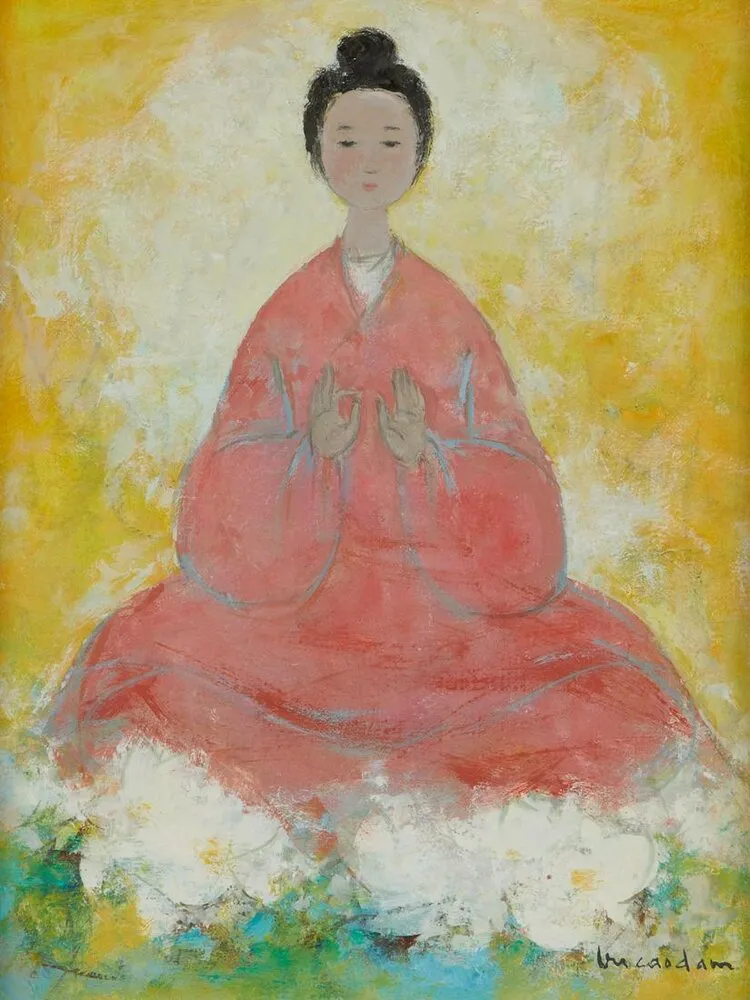
Bảo Đại sat for him too and offered to make him a near-official court sculptor if he came home.5 He stayed. The Manufacture de Sèvres issued a biscuit edition of one of his heads in 1934, and in 1935 he made a head of the Buddha about 1.60 meters high for the Cité universitaire.5 But commissions alone could not support him, and around 1935 he turned more and more to painting on silk.3
1937–1946Silk and war
When Le Pho settled in Paris in 1937 and Mai Trung Thứ arrived, the three began working in a shared style of painting on silk.3 The silk was laid on rigid card, drawn in graphite, painted with brushes and then washed with water to blend the colors.3
In 1936 he had met Renée Appriou, a pianist at the Schola Cantorum, and they married in 1938.1 Their son Michel was born in 1941 and their daughter Yannick in 1942. Le Pho was Yannick’s godfather.1
The war ended his bronzes, because metal was requisitioned, so he turned to painting and to modelled, fired clay.1 His family sheltered in the village of Marcilly, and he cycled the 120 kilometers from Paris at night so as not to be seen.1 In 1944 he moved to Vanves, into the same building as Mai Trung Thứ.1
1946–1998The bust of Ho Chi Minh
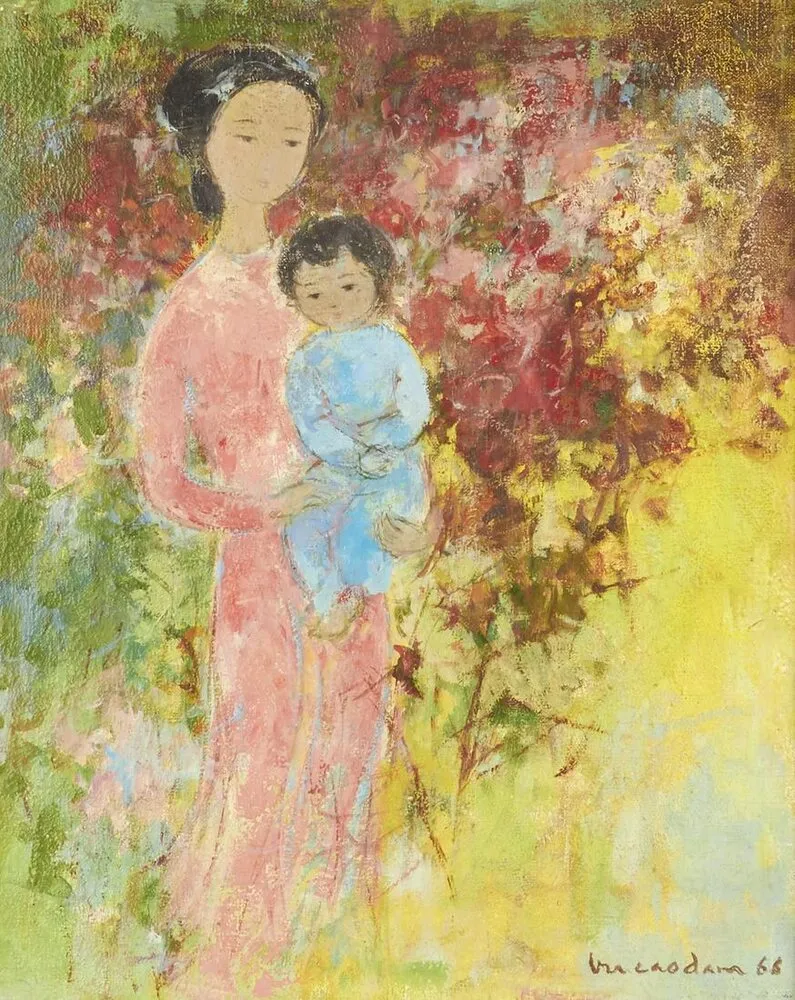
On July 1, 1946, he called on Ho Chi Minh, who was in Paris, and asked to draw and sculpt him.7 The bust he made that summer became the most eventful object of his life. He also made a relief medallion and a bronze medal struck at the Monnaie de Paris, and he gave Ho a silk Maternité. Ho passed it to his hosts, Raymond and Lucie Aubrac, who kept it all their lives.1
The contact drew the attention of French security.8 The family says police searched their home more than once, and in 1950 two further searches took away some of his relief portraits of Ho.2 That year, in Béziers, the family entrusted the bust to a French farming family.2 It stayed hidden for about seventeen years. In 1967 he and his wife went back and found it under straw in a dim storeroom.2
His daughter Yannick had it cast in bronze in Spain in 1996. The bronze reached Hanoi in May 1998 and is now in the Ho Chi Minh Museum.2
1949–1959The south
Years of asthma drove him out of Paris. At the end of 1949 he settled in Béziers.1 His niece Anna modelled for many of the portraits and maternities of those years.5 In July 1952, with the help of the gallerist Alphonse Chave, he moved to Vence, and that November to the villa Les Heures Claires, near the Matisse chapel. He painted the old town from there until Jean Dubuffet’s new studio partly blocked the view.1 Marc Chagall was a neighbor, and an artist he admired.9 He traded paintings for suits with Sapone, the tailor of the artists, whose most famous customer was Picasso.1
His painting changed here. Around 1953 he left pure gouache and silk behind and began to work with egg white, Caparol and more rigid supports, and then in oil.5 He explained the move years later.
“I found silk painting limited by the size of the picture, because of the glass that protects the silk.”4
He also worried that glass spoiled the view of a painting, and he studied varnishes.5 In 1956 a book on the Ajanta caves brought back the interest that Goloubew had awakened in Hanoi.5 A pair of Swiss collectors, Lucie and Roger Tissot, helped arrange exhibitions in Switzerland in 1957.1
1959–2000Saint-Paul-de-Vence
In 1959 he settled for good in Saint-Paul-de-Vence.1 He showed in London in 1960 and in Brussels in 1963, and at the end of 1963 he signed with the Wally Findlay Gallery.1 His daughter believed he met Findlay through Le Pho. Findlay and his sister Helen visited Saint-Paul, but he himself never went to the United States for an opening.1
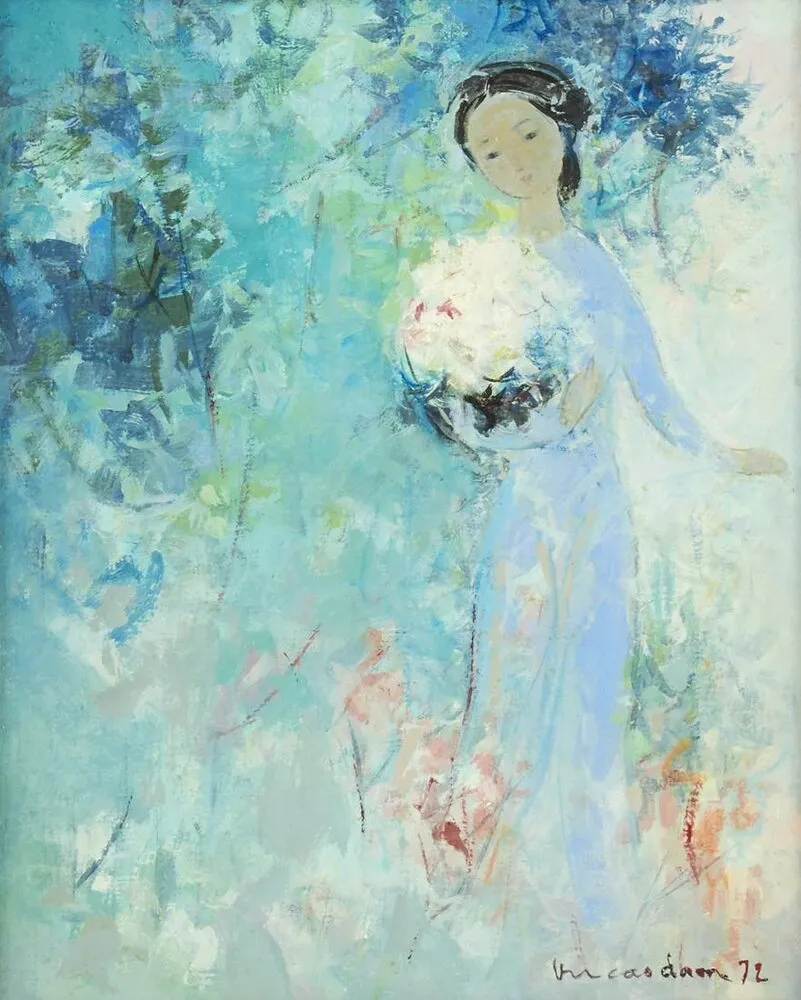
He kept to one great subject. Apart from a few portraits and landscapes, the theme of all his work is Vietnam.5 All his life he said it came from the Tale of Kiều, the national poem, and he chose its moments of happiness and love.5 He wanted his painting to be forte, strong and plastic, and used the word like a mantra.5 Between 1969 and 1971 he issued a series of color lithographs at Saint-Paul.6
He spent summers in Majorca, where in 1985 he took up sculpture again.1 He kept modelling clay into his late eighties, by hand, with wooden spatulas.15 In a statement of 1997 he said he had been “among the first ones” to try to reconcile his “oriental roots” with the art of the West.1 Asked what he would say to young painters, he told Thụy Khuê:
“Keep studying with perseverance, even when you are not satisfied with yourself. Never be discouraged.”4
To visitors at Saint-Paul he would say, “I will return to the earth.”5 He died at Nice on July 23, 2000, aged 92.10 He is buried in the cemetery of Saint-Paul-de-Vence.11
2000–Since 2000
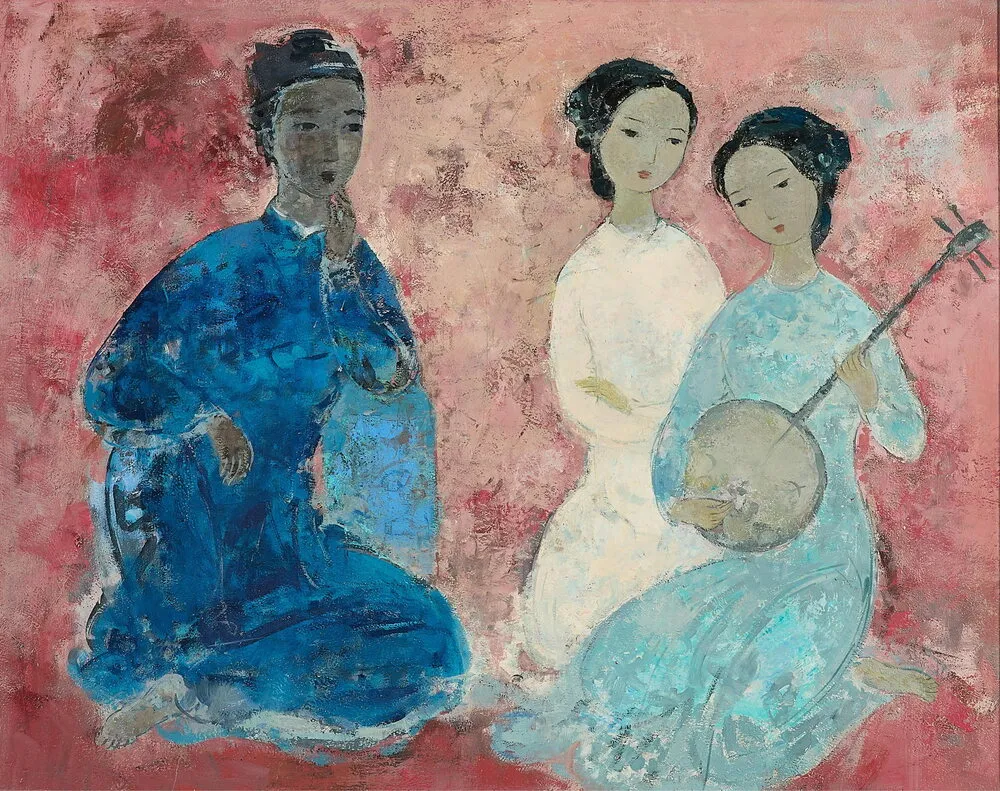
Near the end of his own life Le Pho was asked who was the greatest Vietnamese painter of the twentieth century. He answered, without hesitating, “Vu Cao Dam.”5
The Musée Cernuschi in Paris showed him with Le Pho and Mai Trung Thứ from October 2024 to May 2025.12 In 2025 the museum received twenty of his works: two bronzes given by Béatrice Gervis and eighteen lithographs given by his daughter, Yannick Vu.6 That same year National Gallery Singapore included him in City of Others: Asian Artists in Paris, 1920s–1940s.12
Footnotes
-
Yannick Vu, family biography of Vu Cao Dam, 2019. ↩ ↩2 ↩3 ↩4 ↩5 ↩6 ↩7 ↩8 ↩9 ↩10 ↩11 ↩12 ↩13 ↩14 ↩15 ↩16 ↩17 ↩18 ↩19 ↩20 ↩21 ↩22 ↩23 ↩24 ↩25
-
“Bức tượng chân dung Chủ tịch Hồ Chí Minh và sự trở về kỳ diệu,” Vietnam State Records and Archives. ↩ ↩2 ↩3 ↩4 ↩5
-
Report of a lecture by Anne Fort, “À Paris, rêver du Vietnam: émulation et parenté de style pendant la période parisienne de Lê Phô, Mai-Thu et Vu Cao Dam (1937–1949),” Société des amis du musée Cernuschi, 2024. ↩ ↩2 ↩3 ↩4 ↩5 ↩6 ↩7
-
Thụy Khuê, interview with Vũ Cao Đàm. ↩ ↩2 ↩3
-
Jean-François Hubert, published essays on Vu Cao Dam, 2019–2024. ↩ ↩2 ↩3 ↩4 ↩5 ↩6 ↩7 ↩8 ↩9 ↩10 ↩11 ↩12 ↩13 ↩14 ↩15
-
Paris Musées Collections, records of the Musée Cernuschi. ↩ ↩2 ↩3
-
Ho Chi Minh Museum, chronicle of Ho Chi Minh’s life. ↩
-
National Gallery Singapore, exhibition text for City of Others. ↩
-
Musée Cernuschi, press text for Lê Phô, Mai-Thu, Vu Cao Dam, 2024. ↩
-
Death register of Nice, 2000, as republished at acte-deces.fr. ↩
-
Les Artistes d’Asie à Paris, biography of the artist. ↩
-
National Gallery Singapore, “Asian Artists in Paris: New Narratives” and the City of Others catalogue page. ↩ ↩2
Chronology
-
1908Born January 8 in Hanoi, son of Vu Dinh Thi and Pham Thi Cuc.
-
1925Sits the entrance competition of the École des Beaux-Arts de l'Indochine and places eleventh for ten places. Victor Tardieu lets him follow the classes. source
-
1926Joins the school as a member of its second class. source
-
1927Models a bronze portrait of his father.
-
1928Tardieu organizes a group exhibition with Le Pho, Vu Cao Dam and Mai Trung Thứ.
-
1930Makes Femme nue, now in the Musée du quai Branly. source
-
1931Tardieu selects his sculptures for the Exposition coloniale in Paris. Graduates in June with a scholarship. Sails in November on the D'Artagnan and reaches Paris in December. He never returns to Indochina. source
-
1932Exhibits at the Agence économique de l'Indochine in Paris. Travels to Rome.
-
1933Bronze bust of Paul Reynaud. source
-
1934The Manufacture de Sèvres issues a biscuit edition of one of his heads.
-
1935Makes a head of the Buddha about 1.60 meters high for the Cité universitaire. Visits London.
-
c. 1935Turns increasingly to painting on silk. source
-
1936Meets Renée Appriou.
-
1937Le Pho and Mai Trung Thứ reach Paris, and the three begin working in a shared silk style. Victor Tardieu dies in June. source
-
1938Marries Renée Appriou.
-
1941Son Michel is born.
-
1942Daughter Yannick is born.
-
1944Moves to Vanves, into the same building as Mai Trung Thứ.
-
1946Calls on Ho Chi Minh in Paris on July 1 and makes his portrait bust. One-man show of silk paintings in Paris. source
-
1949Leaves Paris because of asthma and settles in Béziers at the end of the year.
-
1950After police searches, the family entrusts the bust to a French farming family at Béziers. source
-
1952Moves to Vence in July and to the villa Les Heures Claires, near the Matisse chapel, in November.
-
c. 1953Leaves pure gouache and silk for egg white, Caparol and more rigid supports.
-
1957Exhibits in Switzerland, at La Chaux-de-Fonds and Langenthal.
-
1959Settles for good in Saint-Paul-de-Vence.
-
1960Exhibits in London.
-
1963Exhibits in Brussels and signs with the Wally Findlay Gallery at the end of the year.
-
1967He and his wife return to Béziers and recover the hidden bust. source
-
1969–71Issues color lithographs at Saint-Paul-de-Vence. source
-
1985Resumes sculpture during a summer stay in Majorca.
-
1996His daughter Yannick has the bust cast in bronze in Spain. source
-
1998The bronze bust reaches Hanoi in May and is received at the Ho Chi Minh Museum on June 3. source
-
2000Dies at Nice on July 23, aged 92. Buried at Saint-Paul-de-Vence. source
-
2024–25Lê Phô, Mai-Thu, Vu Cao Dam at the Musée Cernuschi, Paris, from October 11, 2024, to May 4, 2025. source
-
2025Twenty works enter the Musée Cernuschi by gift. Shown in City of Others at National Gallery Singapore. source